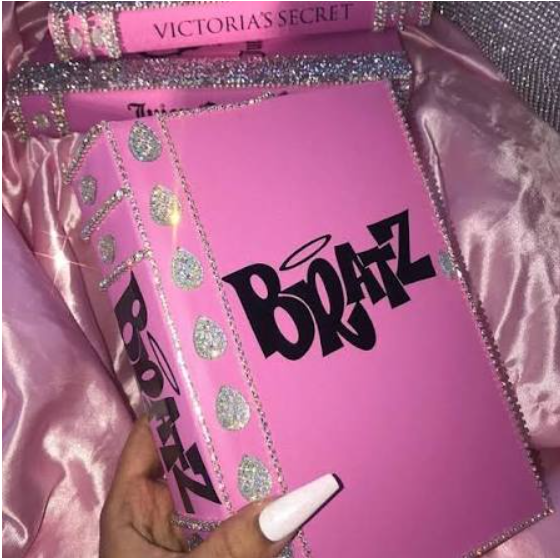
Jes Bernier writes, “So why are we so obsessed with the early 2000’s, a time most of us can’t remember or weren’t even born yet?”
(Photo credit: Pinterest.com)
10/30/2026
Jes Bernier, Journalism Club Member
I’m sure everyone has seen a teenager wearing a full Juicy Couture tracksuit, with Uggs and chunky jewelry to complete the look, becoming a spitting image of 2004 Paris Hilton. Stores are now advertising “low-rise” jeans, new Y2K pieces, and baby doll tops, as GenZ scrambles to check their Depop order status for another vintage Hollister zip-up. I have been this teenager on multiple occasions, as I’m sure you have been or at least noticed others who take after this Y2K trend. This phenomena isn’t only in clothing though. Many have stated they wished for our technology to downgrade to the early two-thousands of clear game consoles and flip phones, romanticized the movies and media of the turn of the century, and idolize the music that many agree is so different from ours, and that it doesn’t feel the same anymore. Many current music artists try to recreate the aesthetic of their brand and music to match that of the famous Britney Spears, like Addison Rae and Olivia Rodrigo. The fashion and media scene isn’t only female-focused though, as men’s fashion has boomed in the Y2K uprise, dawning baggy jeans and Afflictions tees. This grunge style of the early 2000’s and late 90’s has been deemed as “ older brother core”, going beyond even clothing into music taste, and general aesthetics of living off of Monster Energy and Slim Jims.
So why are we so obsessed with the early 2000’s, a time most of us can’t remember or weren’t even born yet? As someone who partook in this trend for a while, dressed in Ed Hardy as I write this, it’s a more complicated answer than just “because it’s cool” or “because the aesthetic is nostalgic”. Have you ever thought about why you are nostalgic for it, a time that seems so far away, but in reality is only two decades old? Our social media screens are flooded with influencers trying on these different vintage clothes, going to Goodwill to find the perfect piece, as always telling us what to buy and when. Our stores have catered to our interests, campaigning new lines, like Aeropostale's 2026 “Y2K Reissue Collection” and Hollister's 2025 “Y2K vault Capsule Collection. The brands know this, the market knows us, influencers know us. But we don’t know why.
A conclusion one could draw could be the stores themselves. The sudden uptick in available fashion of the time could be another culprit, but the market and stores wouldn’t have brought back these lines if they weren’t noticing the consumer behavior itself. According to the Science Survey’s article, “Gen Z’s Y2K Takeover” by Grace Bubier, Google’s Year Search in 2021 states there were 39,000 weekly searches for Y2K fashions, and 3,000 for Y2K makeup weekly. This shows how the consumer's interest has been dictating the choices for these brands, so they are a part of the equation but not the main reason. As much as we like to blame the brands and corporations, they are only part of it.
The other main suspect, as always, is the infamous Covid-19. During this time, social media was our whole world. Instead of entering our awkward middle school phases, we watched influencers show us their makeup routines and introduce the hobbies of their past. We scrolled through TikTok to find our new weekly “core”, we had the time to watch or rewatch older shows, play older video games, and in general indulge in older media. We watched everything we could and engaged in anything virtual we could. We yearned to be transferred back into a perceived safer era, to shift to a different era if you will. According to an article on Nature.Com (Covid-19 Humanities and Social Sciences Perspectives), a study in the UK found that there was an increase in "positive nostalgic music”, similar to the upbeat music of the early 2000’s, even 5 years before 2020. Another piece is younger GenZ, who were not able to experience much of the early part of the century, like their older counterparts, a common phenomenon popularly known as FOMO could be to blame. Knowing that they missed such a nostalgic and sought-after era of originality and wanting to claim it as their own and be allowed to “relive their childhood” or connect with a version of themselves they could’ve been, even though they weren’t alive for it. Therefore with these music artists, celebrities, and influencers introducing fashion from the past, they feel this sense of missing something they’ve never experienced, called “anemoia” or “vicarious nostalgia”. This is a physiological term, and I believe to be the feeling many of us feel today. We vicariously live through the influencers that lived during this time and explore the media within to feel connected. When Covid-19 hit, it boomed the aesthetic and era, rewinding time to escape one that seemed to be crumbling, causing us to yearn for something a lot of us didn’t actually experience but wanted. But why Y2K? Why not the 1950’s or 1970’s? Why such an encompassing focus and draw to this time period?
Well, there are two sides to look at, two political sides. George W. Bush was the President of the United States from 2001 to 2008. Today, many see the 2000’s era, even before President Obama’s term, to be moving somewhat progressively, with many online sharing a similar sentiment of wishing the world was back to simpler times, “like in the 2000s” or when “everyone was more understanding”. While this is a valid feeling for some compared to the drastic difference of political polarization currently, the 2000s were not as progressive as they may seem. The Y2K and 2000s era was known for the aggressive increase in eating disorders or “ana”, an older term used for people suffering from anorexia, used primarily in the online culture. According to the National Institutes of Health (NIH): studies indicated that today roughly 22% of adolescents show signs of an eating disorder, with a global observation of approximately 5.23% or 1 in 20 showing symptoms of any eating disorder (European Child & Adolescent Psychiatry). While similarly, from the 2000 to 2006 period, according to NationalEatingDisorders.org, there was a study showing the eating disorder prevalence globally that increased from 3.5% to 7.8% between 2000 and 2018 (The American Journal of Clinical Nutrition, by Elsevier).
The numbers today are rising steadily to what the diet of the 2000s was. This toxic body dysphoria wasn’t the only social imbalance within the era though, as the use of casual racism and misogyny was abundant, with people using slurs that we deem derogatory now, and the sexism in the counterattack of women in the corporate work place. People often like to remember this era as a “post feminism” place holder, but with the diet culture as one example, industrial paparazzi sexualizing singers and actors, like, again, infamously Britney Spears, and the double standard of sexuality and autonomy. This era of "feminism" was hidden behind women endorsing consumerism through shopping and working office jobs to mask intense sexual harassment (often in said workplace) and the beauty standards being at an all-time high. According to the U.S. Equal Employment Opportunity Commission, in 2001, there were 15,836 workplace sexual harassment charges filed, and 86.3% of those filed were from women. Now, in the 2025 statistics, roughly about 78.2% were filed by women. This era was not more “progressive” by any means; it encouraged deathly eating disorders, had raging racial discrimination, violent misogyny, and same-sex marriage was not even legalized nation-wide in the U.S. until 2015. On the other side of the coin, some may crave that era because of that. We are often deemed the “woke” generation. Online in 2020, also a very tension-filled election year, many, on the more conservative side, were annoyed with this sudden uptick in “left progression”, and it could be that many, even subconsciously, want that “simpler” time.
Or is it simply because of aesthetic purposes? The best answer I can come up with is, yes. Yes to all of it. It is a cycle, for one beauty standard, especially for women, has always cycled back, usually to the same standards of being impossibly skinny. While the 2000s was a massive increase in it, that standard has been around for centuries. The stores are always going to bring back retro pieces, especially if they see resurgence in it within the consumers, we are always going to over-romanticize an era that is not as good as it seems, the Victorian era or Medieval to name a few. We are going to follow social media trends and influencers without a second thought. We are always going to want to connect with something others have connected with, as it is human nature, and in times of bad economies, wars, and social polarization globally, we are always going to seek comfort in the familiar, even if that familiar can be a dangerous cycle, because what else do we have? It is a vicious and vicarious circle of a concept of an era, rather than a factual reliving of itself.